
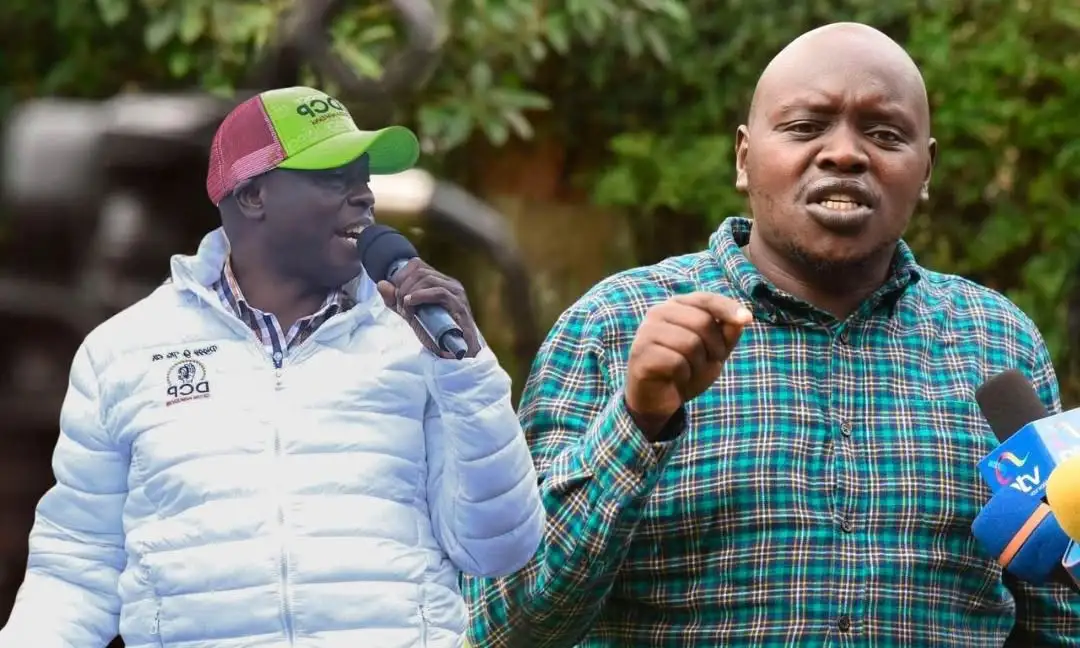
Cherargei Petitions NCIC to Investigate and Prosecute Gachagua Over Alleged Ethnic Profiling
Nandi Senator Samson Cherargei has formally petitioned the National Cohesion and Integration Commission (NCIC) to open an investigation into former Deputy President Rigathi Gachagua, accusing him of a sustained pattern of public remarks that the senator says amount to ethnic profiling of the Kalenjin community.
In a letter dated July 27, 2026 and addressed to the NCIC chairman, Cherargei asks the commission to determine whether Gachagua’s statements made at rallies, in media interviews and during press briefings breach the Constitution and the National Cohesion and Integration Act, and to pursue prosecution if they do.
Quick Summary: Nandi Senator Samson Cherargei has petitioned the NCIC to investigate and prosecute former DP Rigathi Gachagua for alleged hate speech and ethnic profiling of the Kalenjin community. The July 27, 2026 letter cites Article 27 and 33(2) of the Constitution and Sections 13 and 62 of the National Cohesion and Integration Act, and includes a video annexure of remarks Gachagua made after MP George Koimburi’s alleged abduction.
What the Letter Says
The petition centers on claims that Gachagua’s rhetoric has repeatedly linked members of the Kalenjin community to criminality, insecurity and organized violence. Cherargei frames this as part of a broader pattern rather than a single isolated remark, and points to Article 27 of the Constitution, which guarantees equality and bars discrimination on ethnic grounds, alongside Article 33(2), which excludes hate speech and ethnic incitement from constitutional protection for free expression.
He also leans on the National Cohesion and Integration Act itself, specifically Section 13, which prohibits threatening or insulting language intended or likely to stir ethnic hatred, and Section 62, which criminalizes hate speech. Sections 25 and 26 of the Act give the NCIC its mandate to investigate exactly this kind of complaint.
Attached to the letter is a video recording, Annexure SKC-1, of remarks Gachagua reportedly made following the alleged abduction of Kikuyu MP George Koimburi. According to reporting on the letter, Gachagua used the occasion to allege that government officials he identified as Kalenjin had formed a special police unit targeting opposition political figures — a claim that remains unverified.
Four Specific Requests
Cherargei’s letter asks the NCIC to:
- Investigate the statement captured in Annexure SKC-1, along with any related remarks the commission can independently obtain.
- Retrieve original recordings, transcripts and media coverage to establish the full context of the statements.
- Determine whether the conduct violates the Constitution or the National Cohesion and Integration Act.
- Investigate and prosecute Gachagua under that Act.
The senator argues the timing matters. With Kenya edging toward the next General Election, he warns that ethnically charged rhetoric carries outsized risk to public confidence and peaceful electoral conduct, an argument that echoes the country’s fraught history with pre-election political messaging.
Not Gachagua’s First Brush With the Commission
This is far from the first time NCIC has been asked to scrutinize Gachagua’s public statements. The commission summoned him in May 2025 after he likened the 2007/2008 post-election violence to a “Christmas party,” a comparison then-NCIC chairman Rev. Samuel Kobia publicly condemned as trivializing the deaths and displacement suffered by victims. Months earlier, in February 2025, Gachagua drew NCIC scrutiny over remarks in Meru County tied to efforts to remove Chief Justice Martha Koome, which the commission said risked undermining harmony between communities.
By November 2025, the NCIC confirmed it was investigating Gachagua alongside four governors and roughly ten members of parliament over various hate speech allegations. But that momentum stalled: in testimony to the Senate’s National Cohesion Committee in late November 2025, Director of Public Prosecutions Renson Ingonga said the case against Gachagua could not proceed to trial because the evidence file submitted by the NCIC did not meet the threshold needed to secure a conviction.
Cherargei himself has raised the fairness question before. Just days before this latest petition, on July 24, 2026, he publicly accused the NCIC of double standards, arguing the commission should investigate Gachagua’s past reference to the Nandi community as a “militia” before turning its attention to Health Cabinet Secretary Aden Duale, who is separately facing hate speech scrutiny over a controversial Somali-language remark.
What Happens Next
The NCIC has not yet indicated whether it will open a fresh investigation in response to Cherargei’s letter. Given the commission’s patchy track record of turning hate speech complaints into successful prosecutions — the DPP’s own account of the earlier stalled case being the clearest example the outcome here is likely to hinge on whether Cherargei’s office, and the commission itself, can assemble evidence robust enough to survive prosecutorial review.
Gachagua has not yet issued a public response to this specific petition. His Democracy for Citizens Party (DCP) has previously dismissed similar NCIC scrutiny as politically motivated.
