
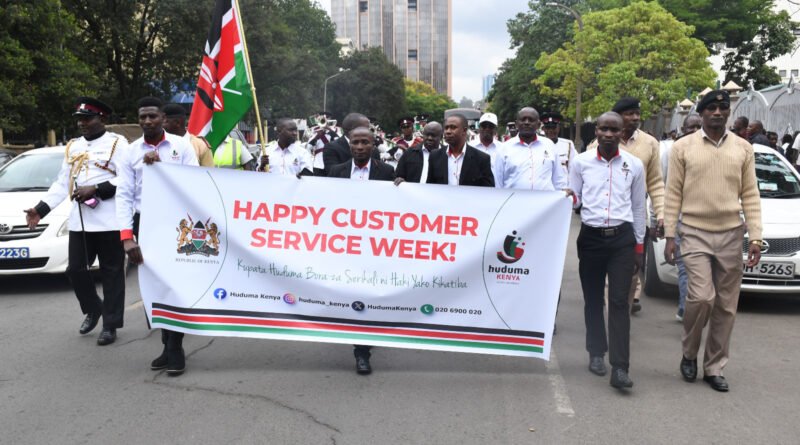
Kenya’s Customer Service Week 2026 Runs Through October 9
Kenya has begun the 2026 National Customer Service Week, with government institutions focusing on making public services more responsive, accessible and centred on the needs of citizens.
The week’s final scheduled day is Friday, October 9, 2026. It runs under the theme “Extra Mile: Transforming Public Service Through Customer Service Excellence” and the national message “Huduma Bora, Taifa Bora.”
Government ministries, departments and agencies used the programme to highlight service reforms, engage citizens and collect feedback. KRA’s published schedule lists a final “KRA at Your Service” commuter outreach today, October 9.
Why Customer Service Week matters
For many Kenyans, the quality of government is experienced through everyday interactions: applying for documents, accessing healthcare, seeking business support, paying taxes, registering property, obtaining licences or following up on public services.
Customer Service Week provides an opportunity to examine those experiences from the citizen’s perspective. A service can be technically available but still difficult to access if information is unclear, processes are slow or citizens are required to make unnecessary visits.
The 2026 programme places emphasis on responsiveness, accessibility, innovation and direct engagement. These areas are increasingly important as more government services move online.
Digital services are a major focus
One of the programme’s areas of attention is the Digital Superhighway and Creative Economy pillar. Government institutions are expected to showcase digital services and innovations designed to reduce barriers for citizens.
Digital transformation can save time when systems are reliable and easy to use. However, it also creates a responsibility to make sure that people who have limited internet access, disabilities or difficulty using digital platforms are not excluded.
Good digital customer service therefore requires clear instructions, accessible interfaces, dependable systems and practical support when users encounter problems.
Healthcare and public information
The Universal Health Coverage pillar will also feature during the week. The focus includes citizen information, outreach and service responsiveness.
For patients, customer service is closely connected to whether they can understand where to obtain care, what documentation is required, how to follow up on services and where to raise concerns.
Public information is especially important in health because delays or confusion can have consequences beyond inconvenience.
Farmers and businesses are part of the agenda
The Agricultural Transformation and Food Security pillar focuses on services for farmers and livestock keepers. This includes access to extension information, agricultural support, market information and other public programmes.
The MSME Economy is another priority. Entrepreneurs often interact with several public agencies while starting, licensing, financing or expanding a business. Clear information and predictable processes can reduce the cost of compliance and allow small businesses to spend more time on productive activity.
KRA places taxpayers at the centre
The Kenya Revenue Authority is also marking Customer Service Week from October 5 to October 9 as part of Taxpayers’ Month 2026. The authority’s programme includes taxpayer engagement, customer visits, public education and accessibility initiatives.
KRA has identified several activities for the week, including public awareness on customs processes, direct taxpayer engagement and commuter outreach. It is also promoting a Kenyan Sign Language handbook covering tax, systems and customs terminology.
These activities reflect a wider principle: compliance is easier when citizens can understand what is required of them and can obtain assistance when they need it.
What citizens can expect
- More public-service exhibitions and demonstrations.
- Direct engagement between citizens and government institutions.
- Public education on selected government services.
- Opportunities to provide feedback on service delivery.
- Greater attention to digital and accessible service channels.
What good customer service should look like after the week
The real measure of Customer Service Week will not be the number of events held during five days. It will be whether useful lessons continue after October 9.
For citizens, that means faster responses, clearer information, fewer unnecessary steps and accessible channels for complaints and feedback. For public institutions, it means treating customer service as part of everyday administration rather than an annual campaign.
The 2026 programme provides an opportunity for government agencies to listen to citizens and identify practical improvements. If those lessons are implemented consistently, the week can have an impact long after the celebrations end.
Why citizen feedback matters
Customer service is not only about the speed of a transaction. It also involves whether citizens understand a process, whether they can obtain help when something goes wrong and whether institutions use complaints to improve their systems.
For public agencies, feedback can reveal problems that internal performance reports do not always capture. Repeated complaints about the same form, online portal, queue or approval process can point to a wider design problem that requires a policy or technology solution.
Kenyans can therefore use Customer Service Week to ask practical questions, report genuine service problems and recognise improvements that make public services easier to access. The week’s scheduled outreach ends today, but the practical test is whether agencies keep responding to complaints and improving access after the events finish.
Sources and verification
This Daily Report KE article was independently written using official information from the Kenya Revenue Authority and the State Department for Public Service. No other news website was used as a quoted source.
