
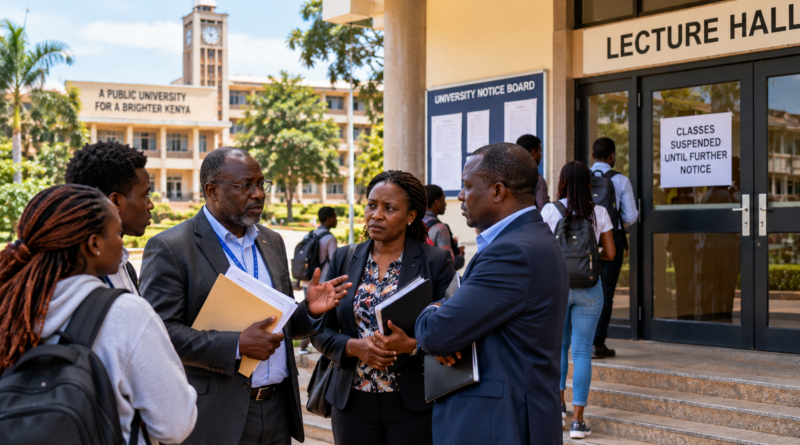
Public University Staff Begin Strike After Unions Reject CBA Offer
Teaching, research and administrative services across Kenya’s public universities face fresh disruption after three university staff unions rejected a counter-offer on the 2025–2029 Collective Bargaining Agreement and called their members out on strike from October 2, 2026.
The industrial action involves the Universities Academic Staff Union (UASU), the Kenya Universities Staff Union (KUSU) and the Kenya Universities and Colleges Allied Workers Union (KUDHEIHA). The unions said negotiations with the Inter-Public Universities Councils Consultative Forum had failed to produce an acceptable settlement on the new CBA.
The dispute matters to thousands of students because the three unions represent lecturers, non-teaching staff and other workers whose absence can affect lectures, examinations, laboratories, libraries, registries, finance offices, accommodation and other campus services.
Why university staff are on strike
The main dispute centres on the 2025–2029 CBA and the amount of money required to implement it. UASU had already issued a seven-day strike notice in late September, saying talks had stalled and accusing university councils, the Ministry of Education and the National Treasury of failing to complete the agreement.
KUSU separately issued its own notice, also setting October 2 as the date for industrial action if outstanding issues were not resolved. Union leaders said they had pursued negotiations and other channels for months without reaching an agreement that their members could accept.
Reporting ahead of the strike showed that the unions were also raising concerns about salaries, allowances, medical benefits, staffing levels and implementation of commitments carried over from earlier negotiations.
What happened in the latest negotiations
The dispute intensified after a meeting between the unions and the Inter-Public Universities Councils Consultative Forum in Machakos. The unions rejected a counter-offer presented during the talks, arguing that it did not adequately address their demands.
UASU had earlier criticised a proposed allocation of about Sh9.76 billion for the CBA, saying the amount would not be enough to finance the full four-year agreement. The employers’ side has been under pressure to balance staff demands with the financial position of public universities and available government funding.
Because negotiations are still possible, the strike does not necessarily mean universities will remain closed for a prolonged period. Previous university labour disputes have ended after new offers, return-to-work agreements or intervention by government agencies.
Which universities are affected?
The strike notice applies to public universities and constituent colleges represented by the unions. However, the level of disruption can vary between institutions depending on staff participation, local management decisions and whether specific services are classified as essential.
Students should therefore avoid assuming that every campus activity has stopped. Universities may issue institution-specific notices on lectures, examinations, research activities, graduation preparations, accommodation, registration and access to administrative offices.
What students should do
Students can reduce confusion by relying on official communication from their own universities. During industrial disputes, unverified social-media posts can circulate quickly and may contain incorrect information about reopening dates or examination changes.
- Check your university’s official website, email and student portal.
- Confirm whether scheduled examinations, practicals or attachments are continuing.
- Keep copies of any official notices changing academic dates.
- Students living away from campus should confirm arrangements before travelling.
- Where registration or fee deadlines are affected, contact the relevant university office for written guidance.
Why the 2025–2029 CBA is important
A collective bargaining agreement sets negotiated employment conditions between workers and employers. In universities, these agreements can cover basic pay, allowances, medical benefits, promotions, workloads and other conditions of service.
When a CBA remains unresolved, staff may argue that their pay and employment conditions are falling behind agreed expectations. Universities, on the other hand, may point to funding constraints and the need for Treasury support before they can commit to large recurrent expenditure.
That tension has made university labour relations a recurring national issue because prolonged strikes can delay academic calendars and increase uncertainty for students and their families.
Could the strike still be called off?
Yes. Industrial action can be suspended if the parties return to negotiations and reach a settlement acceptable to the unions and university employers. Possible steps include a revised financial offer, agreement on implementation timelines or a new return-to-work formula.
Any breakthrough should be confirmed through official statements from the unions, universities or the Ministry of Education. Students should be cautious about treating informal claims of a deal as final until a formal announcement is made.
What happens if the dispute continues?
A prolonged strike could affect teaching schedules, marking, examinations and completion dates. Administrative services may also slow if non-teaching workers participate. Universities may later have to adjust semester dates or introduce recovery programmes to make up for lost teaching time.
The impact will depend on how long the strike lasts and how widely it is observed. Some services may continue even where lectures are suspended.
Why this matters beyond campuses
Public universities employ thousands of academic and non-academic staff and serve students from across the country. Industrial action therefore has effects beyond university gates, including on accommodation businesses, transport operators, suppliers and families financing students’ living costs.
The dispute also raises a broader question about sustainable financing of public universities. Any pay agreement must ultimately be supported by reliable funding if universities are to implement it without worsening existing financial pressures.
Sources
- The Standard: University staff unions reject pay offer and call nationwide strike
- The Star: Why university lecturers planned to strike from October 2
- The Star: KUSU strike notice over stalled CBA
Daily Report KE will update this article when the unions, universities or government announce a settlement, revised offer or changes to the strike.
