
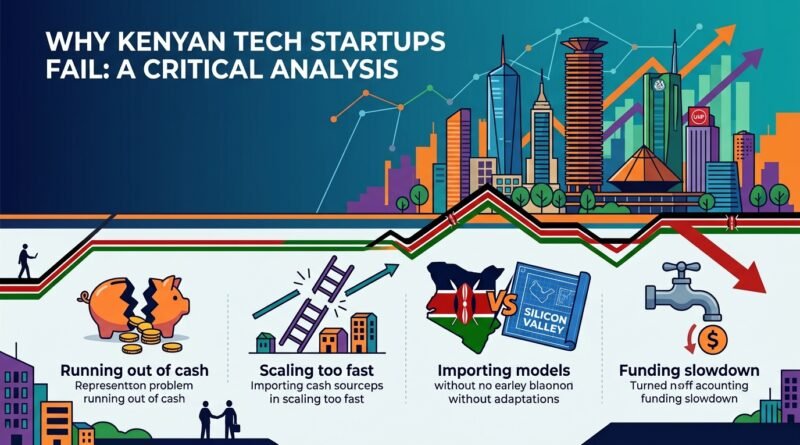
Why Tech Startups Fail in Kenya: 7 Real Reasons (With Case Studies)
Kenya earned its “Silicon Savannah” nickname for good reason. Nairobi has produced some of Africa’s most talked-about tech companies, attracted hundreds of millions of dollars in venture capital, and built a reputation as one of the continent’s most active startup hubs. Kenyan startups pulled in close to a billion dollars in funding in a single recent year, placing the country alongside Nigeria, South Africa, and Egypt as one of Africa’s top investment destinations.
Yet behind the headlines about funding rounds sits a harder story: a long and growing list of well-capitalized Kenyan startups that shut down, laid off staff, or quietly wound down operations. Kune Food, Zumi, Sky.Garden, Copia Global, MarketForce, Sendy, BRCK, WeFarm, iProcure, Notify Logistics the list keeps growing, and it includes companies that raised real money from serious investors.
So why do so many promising Kenyan tech startups fail, even after securing funding? Below is a breakdown of the most common causes, backed by real examples, plus what founders and investors can actually do differently.
Quick Answer: The Main Reasons Startups Fail in Kenya
- Startups burn through cash faster than they generate revenue
- Businesses scale aggressively before their model is proven
- Founders import Western business models that don’t fit local realities
- Thin profit margins collide with low consumer purchasing power
- A global funding slowdown has cut off follow-on capital
- Weak governance and inexperienced leadership teams
- A tough regulatory and macroeconomic environment
Let’s look at each in detail, with real Kenyan examples.
1. Startups Run Out of Cash Before the Business Stabilizes
This is the single most common thread across Kenya’s startup failures. Industry analysis from PwC has pointed out that many startups don’t fail because their revenue potential is weak; they fail because they run out of cash. Aggressive expansion plans, weak internal systems, and high spending levels leave companies exposed to liquidity crunches even after they’ve raised millions of dollars.
Case study: Kune Food. The cloud-kitchen startup raised $1 million in pre-seed funding and shut down less than a year later. It had sold tens of thousands of meals and built a loyal customer base, but selling meals at roughly $3 each simply couldn’t cover rising food costs. When the company went back to investors for its next funding round, the money wasn’t there, and operations stopped almost overnight.
The lesson: raising money is not the same as having a sustainable business. A startup needs a path to profitability that doesn’t depend entirely on the next funding round showing up on schedule.
2. Scaling Too Fast, Too Soon
Investors often push portfolio companies to grow quickly and capture market share before competitors do. That pressure can be fatal when it happens before the underlying unit economics the actual cost of serving each customer have been proven out.
Case study: Copia Global and Twiga Foods. Both companies expanded rapidly across Kenya, chasing scale in rural and peri-urban markets. Copia eventually collapsed under the weight of expensive last-mile logistics combined with limited purchasing power among its target customers. Twiga underwent major layoffs after its leadership acknowledged that the macroeconomic climate had shifted substantially, driving up the cost of capital just as the company needed more of it.
Growth without a solid financial foundation simply means burning cash faster, and in Kenya’s current investment climate, there often isn’t a next round waiting to bail companies out.
3. Importing Silicon Valley Models Without Local Adaptation
A recurring criticism of failed Kenyan startups is that they copy business models proven in the US or Europe without properly adapting them to Kenyan realities: unreliable electricity and internet in some areas, lower average incomes, different transport infrastructure, and different consumer habits.
Solutions built for wealthy, urban professionals abroad don’t automatically resonate with price-conscious Kenyan consumers. Startups that lean on optimistic projections and “best case scenario” thinking, instead of rigorous local research, tend to discover the disconnect only after they’ve already spent the money.
What actually works in Kenya: Products deeply embedded in daily life. Safaricom’s M-PESA mobile money service is the standard example succeed because they solved a real, widely felt problem with a model built specifically around Kenyan infrastructure and consumer behavior, not a copy-pasted foreign template.
4. Thin Margins Meet Low Purchasing Power
Several failed startups shared the same underlying math problem: the cost of delivering their product or service was higher than what Kenyan consumers could realistically pay.
Case study: Sky.Garden and Zumi. Both were e-commerce marketplace ventures that struggled to sustain viable unit economics in Kenya’s fragmented retail environment. Zumi actually started as a digital magazine for women before pivoting to e-commerce when digital ad revenue wasn’t enough to sustain the business, and even after the pivot, and six years of operation with roughly $920,000 raised, it still couldn’t make the model work.
Case study: MarketForce. The retail distribution platform shut down its core business after struggling with thin margins and costly operations, despite raising significant capital.
When your cost to serve a customer is close to or higher than what that customer can pay, no amount of funding delays the inevitable for long.
5. The Funding Slowdown Since 2022
Global venture capital pulled back sharply from 2022 onward, and African startups felt it acutely. Companies that had built their growth plans around a steady pipeline of follow-on funding suddenly found investors far more cautious.
This slowdown directly triggered a wave of closures: Zumi, Kune, Sky.Garden, and later Sendy all cited funding difficulties as a direct cause of their shutdown. More recently, health-tech startup Antara Health exited the Kenyan market citing weak demand and slow growth, Ilara Health cut staff amid funding delays, and electric mobility startup eBee scaled back operations as costs climbed faster than revenue.
Even in a year when Kenyan startups collectively raised nearly $1 billion, that capital wasn’t evenly distributed and companies that had built lean, sustainable operations were far better positioned to survive the drought than those that hadn’t.
6. Weak Leadership and Governance
Many Kenyan startups are founded by young, ambitious entrepreneurs who are strong on vision but light on the operational and financial discipline needed to run a company through hard times. Common patterns include:
- Hiring full teams and renting premium office space before generating meaningful revenue
- Treating investor funding as available cash rather than a resource that needs careful management
- Lacking access to experienced mentors or board members who’ve been through a downturn before
- Struggling to pivot quickly when the original plan isn’t working
A capable, experienced leadership team can often stretch limited funding much further than a well-funded team without that discipline.
7. A Difficult Regulatory and Macroeconomic Backdrop
On top of internal missteps, Kenyan startups operate in an environment shaped by high taxation, costly business licensing, currency depreciation, and policy shifts that are hard to predict. These pressures raise operating costs and squeeze margins that were often thin to begin with, turning a manageable challenge into an existential one.
The Kenyan government has made some efforts to help, including the proposed Startup Bill and programs like the Ministry of ICT’s Whitebox Program, but many founders say the practical impact so far has been limited relative to the scale of the challenge.
What This Means for Founders and Investors
The failures above don’t mean Kenya’s tech ecosystem is broken; they’re a signal of what needs to change. A few practical takeaways stand out:
- Validate the unit economics early. Prove that serving one customer profitably is possible before trying to serve a million.
- Build for Kenyan realities, not imported assumptions. Research actual consumer behavior, income levels, and infrastructure constraints before designing the product.
- Treat funding as a tool, not a finish line. A funding round buys time to reach sustainability; it isn’t sustainability itself.
- Hire for financial discipline, not just vision. Experienced operators who’ve navigated a downturn are worth more than an impressive pitch deck.
- Plan for funding droughts. Assume the next round might not come on schedule, and build a runway that survives that scenario.
Frequently Asked Questions
Why do so many funded startups still fail in Kenya? Because raising capital doesn’t fix a broken business model. Analysis from PwC and others shows that many well-funded Kenyan startups exhaust their cash reserves through aggressive spending and expansion before their operations become genuinely sustainable.
What sectors have the highest startup failure rates in Kenya? Technology, agriculture, and healthcare tend to see the highest failure rates, often due to high operating costs, thin margins, and infrastructure challenges specific to those sectors.
Which major Kenyan startups have shut down? Notable examples include Kune Food, Zumi, Sky.Garden, Copia Global, MarketForce, Sendy, BRCK, WeFarm, Notify Logistics, and iProcure, among others.
Is Kenya still a good place to start a tech company? Kenya remains one of Africa’s most active tech investment markets, with strong mobile money infrastructure and a large, young, connected population. The failures highlighted here are less a sign that the market is unworkable and more a lesson in the specific mistakes to avoid.
Editorial Note: This article is based on publicly available reporting and market analysis current as of 2026. Corporate status and business circumstances can change rapidly; readers should verify updates directly through primary corporate filings and announcements.