
KRA Collects KSh 1.01 Trillion by October 2026 as Customs Revenue Hits Record High
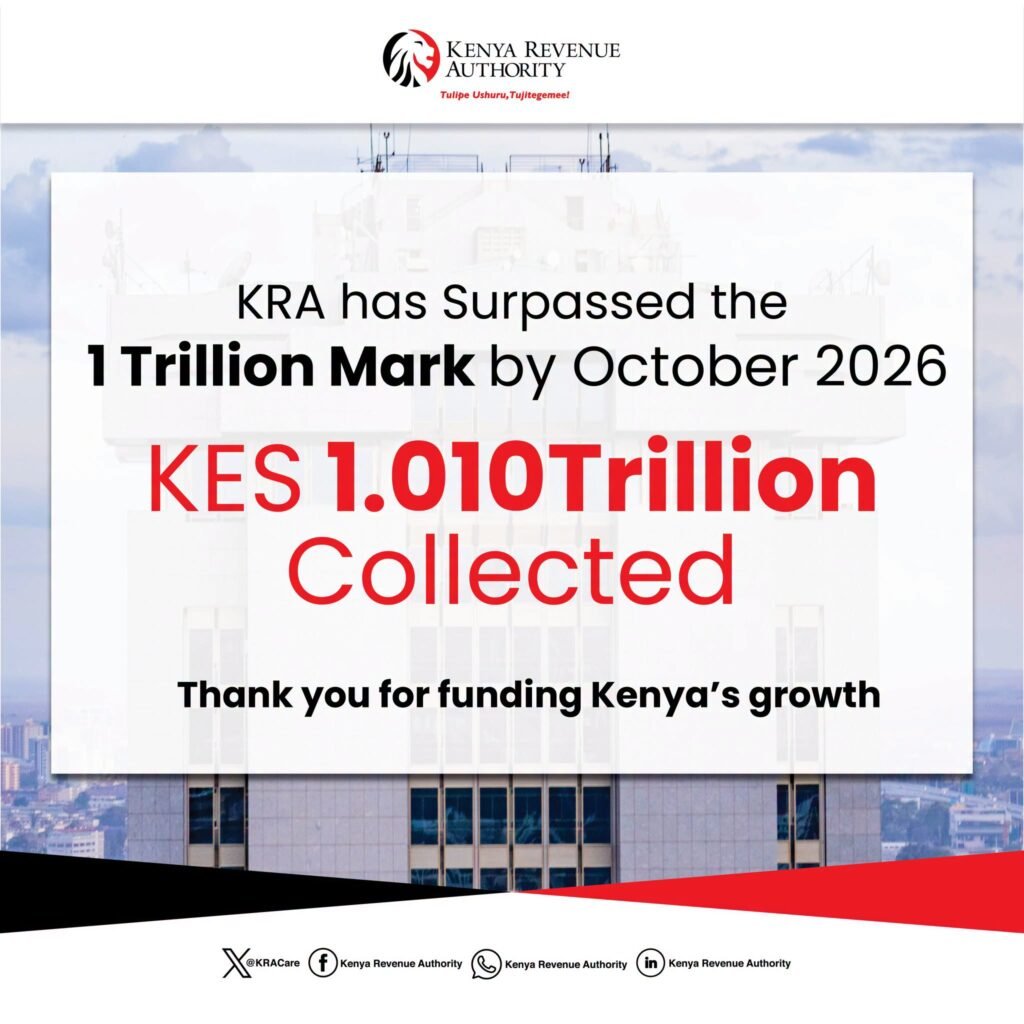
The Kenya Revenue Authority (KRA) collected KSh 1.010 trillion between July and October 2026, reaching the trillion-shilling milestone one month earlier than in previous financial years.
The milestone was announced in KRA’s official press release dated Thursday, 5 November 2026. The authority said October revenue alone totalled KSh 260.630 billion against a target of KSh 258.304 billion, exceeding the monthly goal by approximately KSh 2.327 billion.
Featured graphic: Kenya Revenue Authority’s official announcement of KSh 1.010 trillion in cumulative collections by October 2026. Source: Kenya Revenue Authority, 5 November 2026.
October revenue beats target

KRA reported 15.5% year-on-year growth in October collections, compared with growth rates of 8.0% in October 2025 and 6.5% in October 2024. Its 100.9% target performance reflects collections slightly above the amount set for the month.
That distinction matters: the KSh 1.010 trillion figure is cumulative revenue over four months, not the amount collected in October alone.
Customs posts highest-ever monthly collections

Customs revenue reached KSh 94.793 billion in October, the highest monthly figure reported by the department. It surpassed the previous record of KSh 92.527 billion collected in July 2026.
The department exceeded its target by KSh 1.009 billion and recorded 11.3% growth over the corresponding period in the previous financial year. KRA said non-oil taxes drove much of the improvement, recording a surplus of KSh 7.243 billion and 26.0% growth.
Domestic revenue grows 18.1%

Domestic revenue reached KSh 165.447 billion against a target of KSh 164.110 billion, a surplus of KSh 1.337 billion and year-on-year growth of 18.1%.
According to the authority, above-target receipts were recorded in several categories, including corporation tax, domestic VAT, domestic excise duty, individual income tax, capital gains tax and stamp duty.
Corporation tax
Corporation tax contributed KSh 23.932 billion against a target of KSh 20.077 billion, representing 31.6% growth. KRA reported that electricity, manufacturing, transportation and wholesale trade together accounted for approximately 81% of corporation tax collected in October.
Domestic VAT
Domestic value-added tax generated KSh 33.367 billion, around KSh 45 million above target. Its year-on-year growth was 22.1%.
Domestic excise duty
Domestic excise collections exceeded the target by KSh 945 million and grew 54.1% from a year earlier. KRA linked the improvement to higher remittances in selected alcoholic beverage and tobacco categories, while noting declines in some soft-drink and bottled-water remittances. The sector-specific changes underscore that the overall revenue gains were not uniform across every product category.
What does the KSh 1 trillion milestone mean for Kenyans?
The earlier milestone points to stronger revenue mobilisation in the opening months of the financial year. Tax receipts help finance public services, infrastructure and other government expenditure, although the amount collected does not in itself show how efficiently money is spent or whether household financial pressure is easing.
Revenue growth can arise from several factors, including changes in economic activity, imports, tax administration, compliance and tax policy. The October figures alone cannot establish how much each factor contributed.
How far is KRA from its full-year target?
KRA is targeting KSh 3.268 trillion for the 2026/2027 financial year. After the first four months, it had collected KSh 1.010 trillion—approximately 30.9% of that annual goal—with about KSh 2.258 trillion still to raise over the remaining eight months.
The revenue authority says it expects to maintain the upward trend. Whether it meets the annual target will depend on collections over the rest of the year, not simply the strong October performance.
Official source
This article reports the figures in KRA’s official press release issued on 5 November 2026 and provides additional context on what the milestones do and do not mean.
