
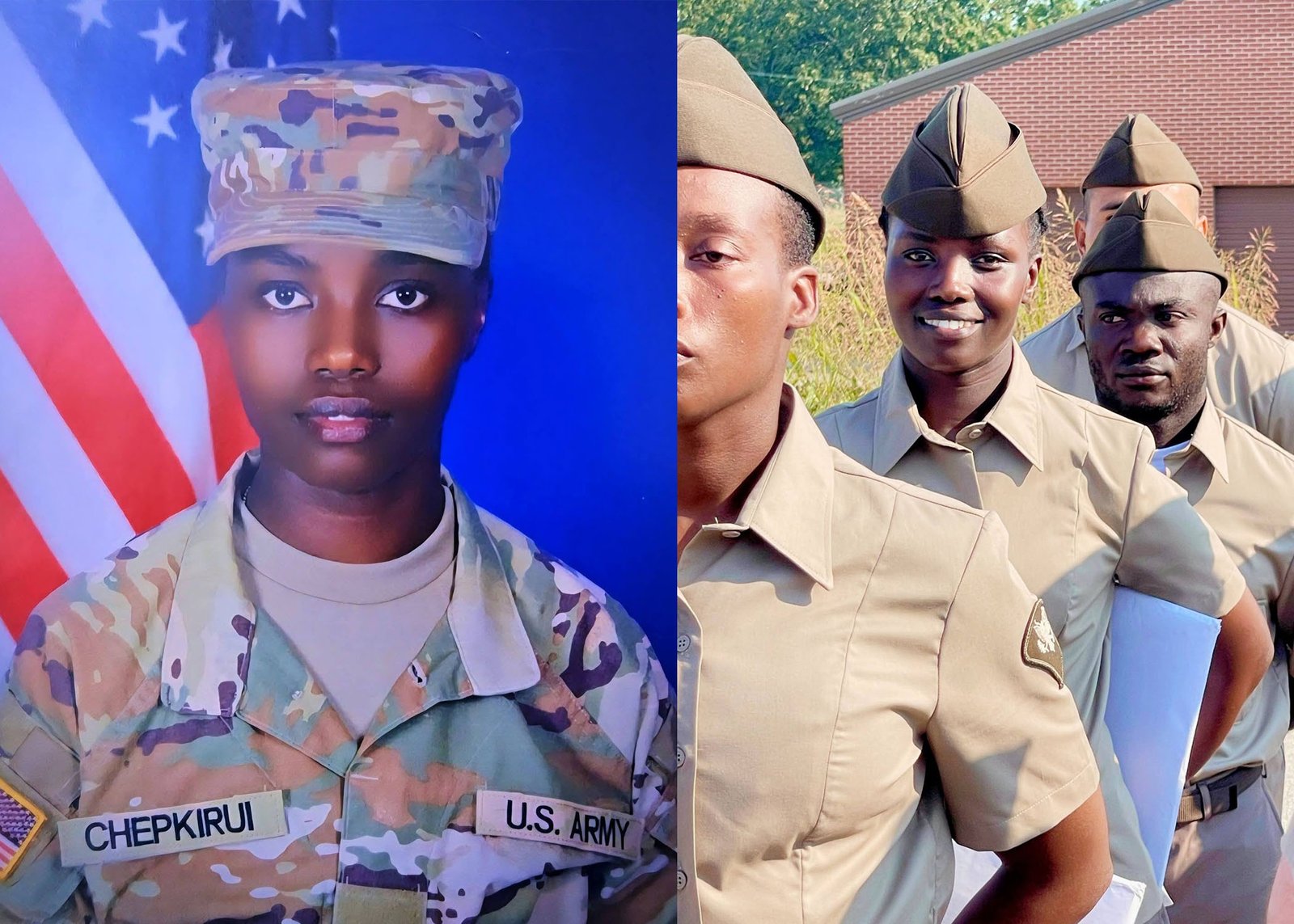
Kenyan Woman Graduates from US Army Training: How Kenyans Can Join the US Army
A Kenyan woman has attracted attention after celebrating her graduation at a United States Army installation in Missouri, prompting questions about how foreign nationals, including Kenyans studying or living in the United States, can become eligible to serve in the U.S. military.
Judie Sigei shared a celebratory moment at Fort Leonard Wood, Missouri, where friends and well-wishers congratulated her on what they described as her graduation as a soldier.
One of the posts celebrating Sigei described the moment as one of pride and joy, with friends congratulating her and referring to her as a soldier.
The development has also sparked curiosity among Kenyans, particularly students and young people who may wonder whether studying in the United States can eventually provide an opportunity to serve in the U.S. military.
Can a Kenyan join the U.S. Army?
Yes, a Kenyan national can potentially become eligible for U.S. military service, but Kenyan citizenship alone is not enough.
According to the U.S. government’s official requirements, some non-U.S. citizens can enlist in the American military. A non-citizen generally needs to hold a U.S. Permanent Resident Card, commonly known as a Green Card, and must speak, read, and write English fluently.
The U.S. government also makes an important clarification: people cannot join the military as a method of entering the United States or obtaining a U.S. visa.
This means that a Kenyan student who enters America on a student visa does not automatically become eligible to enlist simply because they are studying at a U.S. college or university.
What about Kenyan students in the United States?
For a Kenyan student, immigration status is particularly important.
A student may legally study in the United States without being a permanent resident. However, the military’s eligibility rules for non-citizens are different from ordinary student or employment rules.
The U.S. government states that non-citizens seeking to enlist must have permanent resident status. Therefore, studying in America should not be confused with having permanent residency.
A person who eventually becomes a lawful permanent resident may have a different set of options from someone who remains in the United States solely on a temporary student status.
The process of obtaining permanent residence is an immigration matter and depends on the individual’s circumstances. U.S. government guidance notes that Green Card eligibility can arise through different categories, including certain family and employment-based circumstances.
Basic requirements for military enlistment
Beyond immigration status, the U.S. military has additional eligibility standards.
The U.S. government’s current guidance says people seeking to enlist must meet requirements concerning age, education, testing, physical fitness and medical eligibility.
For the Army, the published active-duty age range is generally 17 to 35, although exceptions can apply in some circumstances. Applicants also generally need a high-school diploma or equivalent and must complete the Armed Services Vocational Aptitude Battery, commonly known as the ASVAB.
A medical examination is also part of the enlistment process, while military branches maintain their own standards.
These requirements mean that immigration eligibility is only one part of the overall process.
What happens at Fort Leonard Wood?
Fort Leonard Wood in Missouri is an important U.S. Army training installation.
The installation conducts Basic Combat Training, which the Army describes as a 10-week program designed to turn recruits into disciplined Soldiers and teach fundamental military skills, Army values and basic warrior tasks.
The training is divided into several phases.
The early stages focus on introducing trainees to military life, Army values, discipline and teamwork. Later phases progressively develop skills and include activities such as marksmanship, land navigation and field training.
The final phase culminates in graduation, which the Army describes as marking the transition from civilian to Soldier.
Fort Leonard Wood also hosts more advanced training for Soldiers in particular military occupational specialties.
For example, the installation conducts Military Police training, where Soldiers undergo Basic Combat Training and Advanced Individual Training as part of the Military Police One Station Unit Training program.
Graduation does not necessarily mean the end of training
One important distinction is that military “graduation” does not necessarily mean that a Soldier has completed every form of military training.
The U.S. Army has different training stages and schools depending on a Soldier’s role.
Fort Leonard Wood’s official graduation calendar, for example, lists graduations involving Engineer, Military Police and other Army training units.
The installation also hosts specialized leadership courses for Soldiers who progress in their military careers.
Therefore, without additional information from Judie Sigei herself, it would be inappropriate to state exactly which Army course she completed based solely on the social-media posts provided.
The citizenship question
Another question that often arises is whether a non-American who serves in the U.S. military can eventually become a U.S. citizen.
Military service can provide special naturalization provisions for eligible service members. USCIS has a specific military naturalization process, including documentation confirming military service.
However, military service should not be viewed as an automatic route to citizenship. Eligibility for naturalization depends on the applicable law and the individual’s circumstances.
What avenues are available to Kenyans interested in the U.S.?
For Kenyans, the important distinction is between immigration to the United States and military eligibility.
There are legitimate immigration routes through which a person may potentially obtain permanent residence, depending on their circumstances. U.S. government information identifies family-based and employment-related categories among the possible routes to permanent residence.
The Diversity Visa program is another immigration program that makes a limited number of immigrant visas available to nationals of eligible countries each year, although eligibility and participating countries can change from one year to another.
For someone already legally living in the United States, immigration law may also provide certain avenues for adjusting status to permanent residence when the person qualifies.
These immigration routes are separate from military recruitment. Obtaining a student visa, for example, does not itself confer permanent residency or military eligibility.
Judie’s achievement raises a bigger question
For many Kenyans, Judie Sigei’s apparent achievement at Fort Leonard Wood is more than a graduation photograph. It raises questions about the different educational, immigration and professional journeys that can eventually lead a foreign-born person to a career in the United States military.
Her story also demonstrates why it is important to distinguish between studying in America, living in America as a permanent resident, becoming a U.S. citizen, and serving in the U.S. military. These are different legal statuses and pathways.
For now, the details publicly available in the posts supplied for this story confirm the celebration of Sigei at Fort Leonard Wood and the congratulations from friends, but they do not establish her immigration status, military occupational specialty, enlistment date or the precise training program she completed.
Those details would need to be confirmed directly with Sigei or through an authoritative Army source before being reported as fact.
Key takeaway
A Kenyan does not simply travel to America and enlist in the U.S. Army.
For non-U.S. citizens, lawful permanent residence, English proficiency, and the other military eligibility requirements are central considerations. A student visa alone does not provide eligibility, and the U.S. government explicitly states that military service cannot be used as a means of obtaining a U.S. visa.
Judie Sigei’s graduation at Fort Leonard Wood therefore offers an interesting example of a Kenyan reaching a U.S. military training milestone, but the exact immigration and professional journey that brought her there remains a story best told with confirmation from Sigei herself.
