
Ruto, Putin Agree to Halt Kenyan Military Recruitment as Russia Scholarships and Labour Talks Expand
NAIROBI, 31 October 2026 — President William Ruto says Russia has agreed to stop enlisting Kenyans into its military following talks with President Vladimir Putin at the Kremlin in Moscow, as the two governments discussed repatriation, education, labour mobility and economic cooperation.
In a public statement after the Russia–Africa Summit, Ruto said Putin had confirmed that Kenya was classified as a “non-source country” for Russian military recruitment. The commitment comes amid concerns over Kenyans who travelled to Russia and subsequently became involved in the war against Ukraine.
Defence attaché to coordinate return and compensation
Ruto announced the appointment of a defence attaché at Kenya’s embassy in Moscow to work with the Russian Ministry of Defence on the return of affected Kenyans and the processing of compensation claims. The statement did not specify the number of people to be returned, a payment schedule or eligibility criteria for compensation.
The appointment and the stated commitment do not mean repatriation or compensation has already been completed. Families seeking assistance should rely on official Kenyan diplomatic channels and avoid unverified agents demanding money.
Russia scholarships: proposal to expand from 70 to 300
Education was another priority in the talks. According to Ruto, the leaders discussed expanding scholarship opportunities for Kenyan students from 70 to 300, covering health, artificial intelligence, technology, aviation and cybersecurity.
That represents a proposed increase of 230 opportunities. However, the statement did not provide a new application portal, opening date, eligibility rules or confirmation of individual awards. Students should wait for formal notices from the relevant education and diplomatic authorities before applying or paying anyone claiming to offer placements.
Proposed bilateral labour agreement
The presidents also agreed that their governments would negotiate a bilateral labour agreement intended to provide a framework for Kenyans to live and work in Russia. This is a proposal for further negotiation, not an already operational work-visa programme or a guarantee of jobs. No recruitment portal or approved employer list was announced in the statement.
Five cooperation instruments signed
Ruto said Kenya and Russia signed five instruments during the summit. They cover:
- Establishment of an Intergovernmental Russia–Kenya Commission on Economic Cooperation.
- Cooperation in labour inspection and employment promotion.
- Cooperation between the two countries’ transport ministries.
- Visa-free travel for holders of diplomatic and service passports — not an exemption for ordinary tourist passports.
- Collaboration in diplomatic training.
The proposed wider bilateral labour agreement is distinct from the signed labour-inspection and employment-promotion instrument. Detailed implementation schedules were not provided in the President’s statement.
Support for UN Office in Nairobi and invitation to Kenya
Ruto further said Putin had committed to support the expansion of the United Nations Office in Nairobi. He also disclosed that he invited the Russian leader to visit Kenya. The statement did not specify a date for such a visit.
What happens next?
Key developments to watch include the official procedure for returning affected Kenyans, terms of any compensation, published scholarship application requirements, negotiations on the proposed labour agreement and implementation of the five signed instruments.
For readers considering overseas study or work, the important distinction is between a diplomatic announcement and a fully launched application process. Daily Report has not independently verified any new Russian work placement or scholarship application linked to these talks.
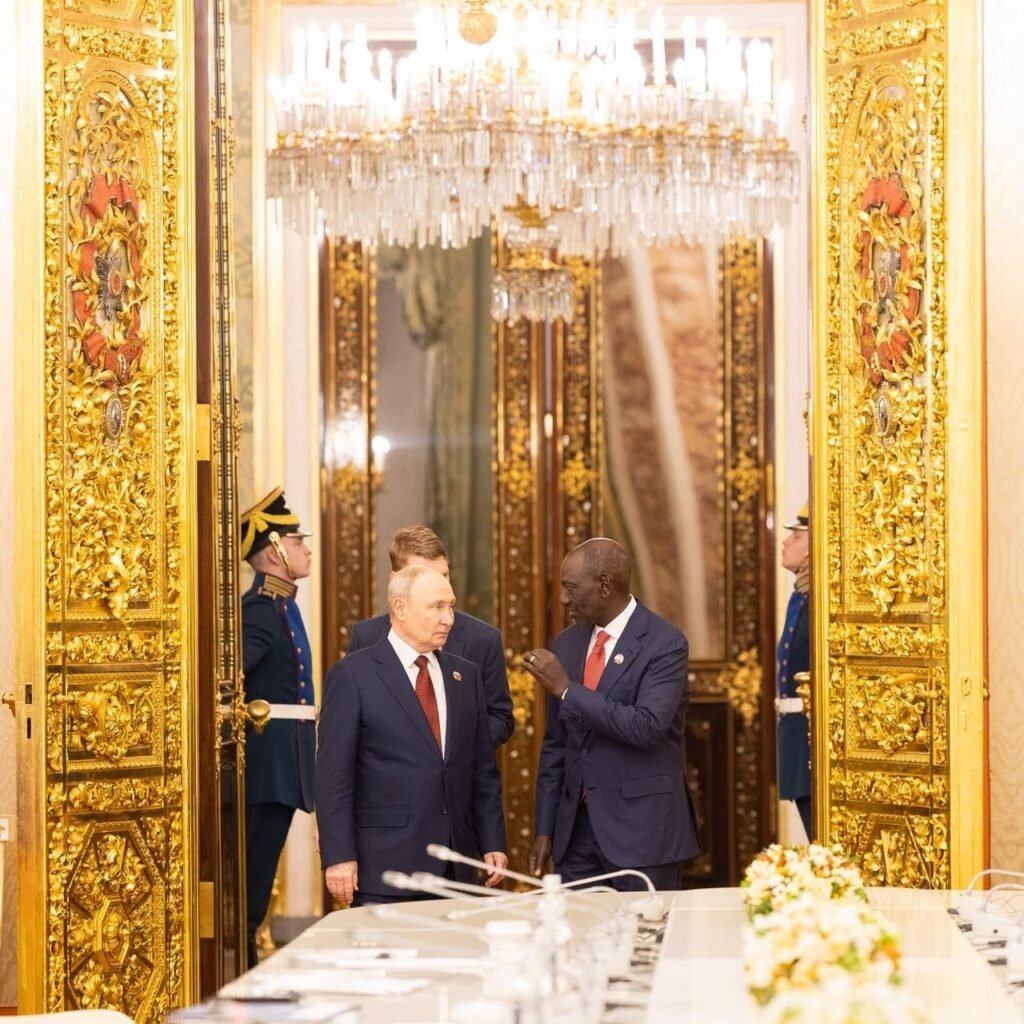
Featured photograph: President William Ruto and President Vladimir Putin at the Kremlin, Moscow. Image supplied for this report.
Sources
President William Ruto’s public statement, 30 October 2026; Anadolu Agency, 31 October 2026; People Daily, 31 October 2026.
