
Kenya Discharges Five Ebola Patients as 46 Contacts Complete Quarantine, Health Ministry Says
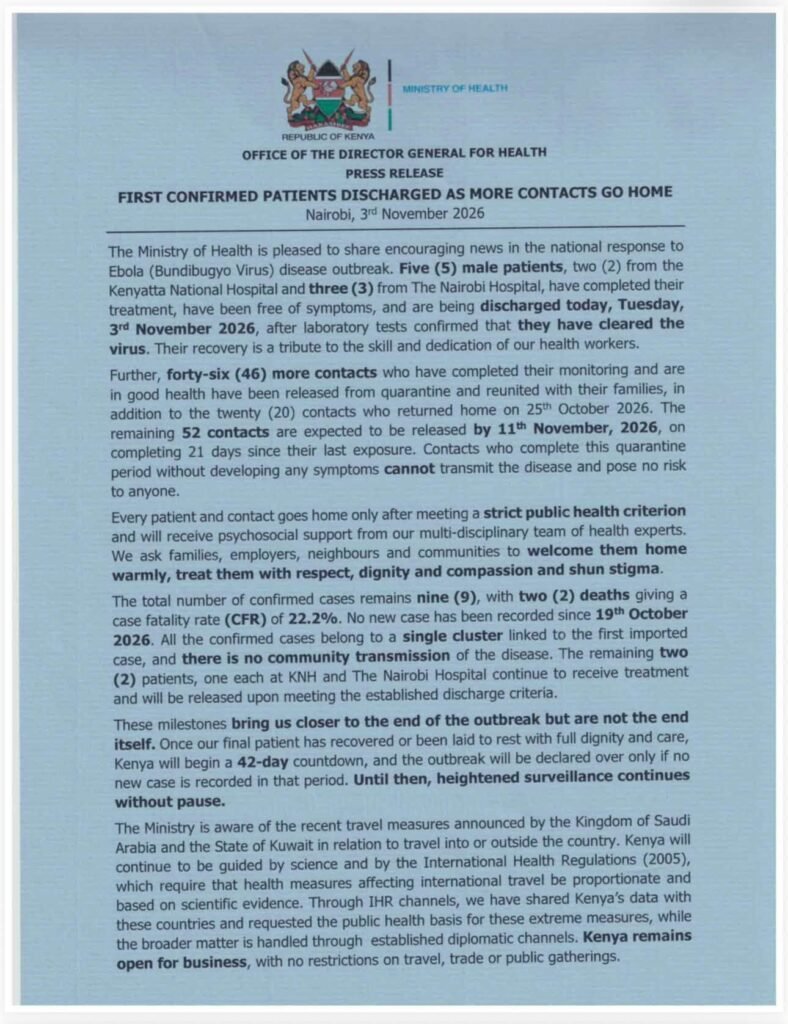
NAIROBI, Kenya, November 3, 2026 — Kenya’s Ministry of Health says five people treated for Ebola (Bundibugyo virus disease) have recovered and are being discharged from hospital after tests confirmed they had cleared the virus, marking progress in the country’s response to the outbreak.
In a statement dated Tuesday, November 3, Director General for Health Dr Patrick Amoth said two of the recovered patients had been treated at Kenyatta National Hospital and three at The Nairobi Hospital. All five were male and had completed treatment, remained symptom-free and met laboratory discharge criteria.
Another 46 people who had been monitored following possible exposure have completed their 21-day observation period in good health and have been released from quarantine. This follows the release of 20 contacts in late October, bringing the number cleared from monitoring to 66, according to the Ministry.
Kenya’s Ebola situation as of November 3
- Confirmed cases: Nine.
- Deaths: Two.
- Recovered patients discharged on November 3: Five.
- Patients still receiving treatment: Two — one at Kenyatta National Hospital and one at The Nairobi Hospital.
- Additional contacts released from quarantine: 46.
- Contacts still being monitored: 52, expected to complete monitoring by November 11 if they remain well.
- Most recent reported new case: October 19, 2026.
The reported case fatality rate is 22.2 per cent, reflecting two deaths among nine confirmed cases in this small outbreak. That figure describes the observed cases and is not an estimate of the risk for any particular person.
The Ministry says all nine cases belong to one cluster linked to the first imported case and that, as of this statement, there is no evidence of community transmission. That assessment does not mean the outbreak has formally ended: surveillance and contact monitoring continue.
Why the outbreak has not yet been declared over
Dr Amoth said authorities will begin a 42-day countdown only after the final patient has recovered or been laid to rest under appropriate infection-prevention procedures. If no new case is recorded during that monitoring period, the outbreak may then be declared over under the public-health criteria outlined by the Ministry.
Healthcare workers continue to monitor the remaining patients and contacts. People who complete the required monitoring period without developing symptoms can rejoin their families and communities without being treated as a public-health threat, the Ministry said.
Saudi Arabia and Kuwait travel measures
The Ministry also acknowledged recent measures announced by Saudi Arabia and Kuwait in response to the Ebola situation. It said Kenya had shared outbreak information through channels established under the International Health Regulations and requested the scientific basis for the restrictions.
The government said it was pursuing the matter through diplomatic channels and maintained that Kenya had not imposed domestic restrictions on travel, trade or public gatherings. Those domestic conditions should not be confused with entry rules independently imposed by other countries.
In a separate statement on November 3, Africa CDC also called for the removal of Ebola-related travel restrictions it considered unjustified by the available epidemiological data.
For further information on the impact of these entry measures on travellers, see Daily Report’s earlier coverage: Kenyan workers return home following Saudi Arabia entry restrictions.
What the public should know
The Ministry urged anyone experiencing symptoms potentially associated with Ebola, especially people with a possible exposure history, to seek prompt medical evaluation and disclose relevant contacts or recent travel to healthcare workers. Early assessment allows health teams to provide appropriate care and prevent further spread.
People can contact the Ministry’s toll-free health reporting line at 719, or send an alert through its WhatsApp chatbot at 0700 719 719, according to the official statement. The Ministry also urged communities to treat survivors and their families with dignity and avoid stigma.
Official statement and sources
The Ministry’s November 3 press release, signed by Dr Patrick Amoth, is available in two pages: read page one and read page two.


