
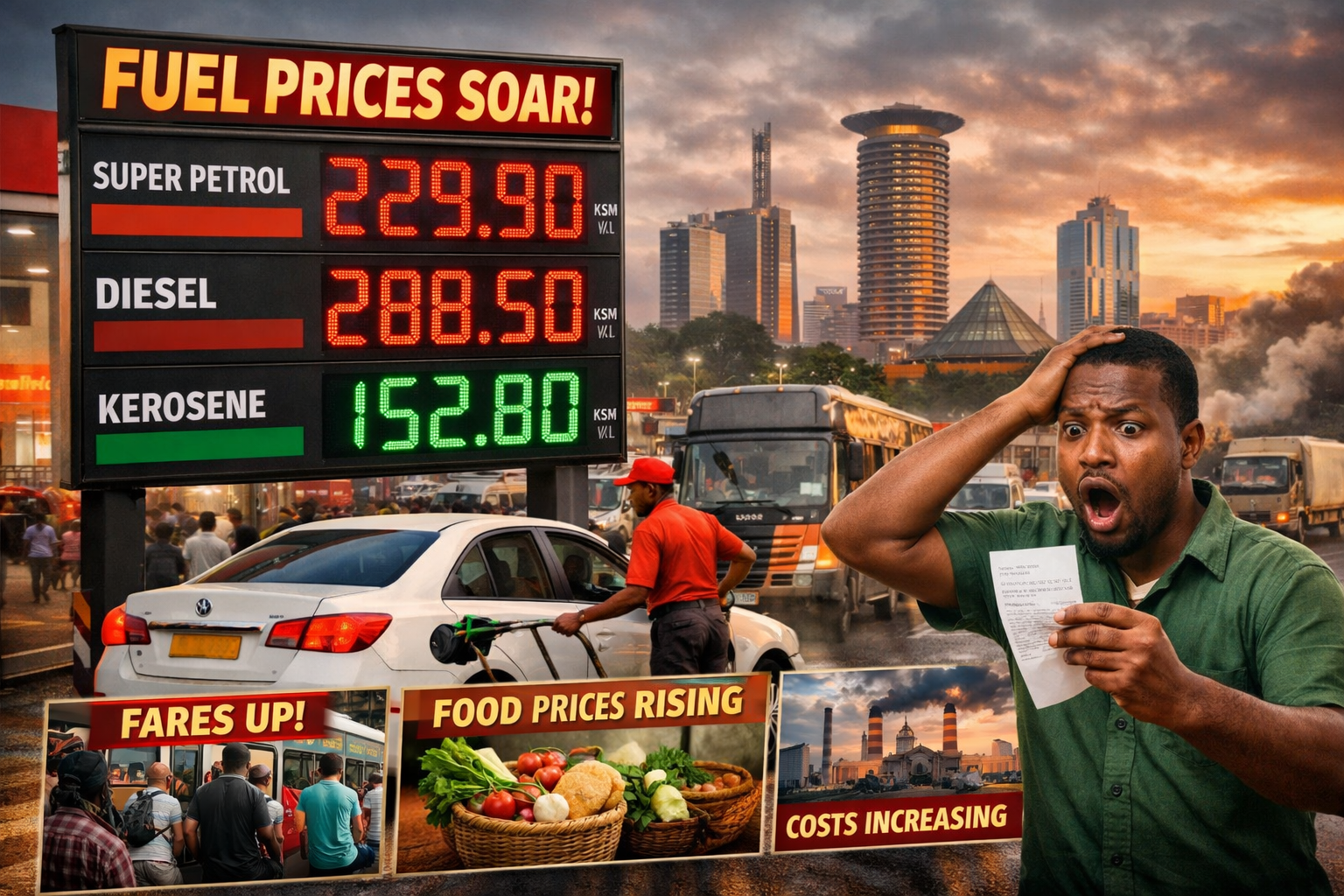
EPRA Shocks Kenyans: Why Fuel Prices Have Surged to Record Highs
By Faith Jepkirui
Table of Contents
NAIROBI, Kenya , Kenyan motorists, transporters, and businesses awoke on Thursday to a fuel price shock that economists are calling one of the most severe single-cycle increases in recent years.
The Energy & Petroleum Regulatory Authority (EPRA), in a gazette notice signed by Acting Director General Dr. (Eng.) Joseph Oketch, announced that the maximum retail price of Automotive Diesel will rise by KSh 46.29 per litre, while Super Petrol increases by KSh 16.65 per litre for the period 15th May to 14th June 2026. Kerosene, the cooking and lighting fuel relied upon by millions of low-income Kenyan households has been held flat.
The new prices take effect at midnight tonight and will remain in force for thirty days.
Why Are Prices So High?
The short answer is Kenya buys all of its refined fuel overseas, priced in US Dollars. When global markets move, Kenyan consumers follow and global markets have moved sharply.
Between March and April 2026, the internationally traded price of Diesel surged by 20.32 per cent, rising from US$1,073.82 to US$1,291.98 per cubic metre. Super Petrol climbed 10 per cent, from US$823.27 to US$906.23. These are the raw landed costs before transport, storage, taxes, or dealer margins are factored in.
The longer view is even more striking. In May 2025, the international price of Diesel was US$563.84 per metric tonne. By April 2026, it stood at US$1,393.50 per metric tonne an increase of nearly 150 per cent over twelve months. Petrol has moved from US$671.79 to US$1,060.01 over the same period.
📈 International Fuel Price Trend (US$/Metric Tonne)
| Month | Super Petrol | Diesel | Kerosene |
|---|---|---|---|
| May 2025 | 671.79 | 563.84 | 598.43 |
| January 2026 | 642.73 | 580.65 | 635.03 |
| March 2026 | 973.39 | 1,383.78 | 1,512.68 |
| April 2026 | 1,060.01 | 1,393.50 | 1,542.55 |
Source: EPRA Monthly Price Review, May 2026
The Kenya Shilling provided minimal cushion. The April 2026 exchange rate was KSh 129.56 per US Dollar fractionally stronger than March’s KSh 130.08 far too marginal a shift to offset a 20 per cent surge in diesel import costs.
“Without the PDL stabilisation fund, Diesel would currently retail at over KSh 334 per litre in Nairobi nearly KSh 100 above today’s announced price.” EPRA Cost Breakdown, Annex II, May 2026
Government Deploys KSh 5 Billion Subsidy
Government Intervention
KSh 5 Billion PDL Fund Activated to Cushion Consumers
The Government of Kenya has deployed approximately KSh 5 billion from the Petroleum Development Levy (PDL) Fund this cycle to absorb a significant portion of the global price surge shielding diesel consumers from a price that would otherwise exceed KSh 334 per litre in Nairobi.
Without government intervention, the price increases would have been catastrophic. The Petroleum Development Levy Fund, a stabilisation mechanism established to buffer consumers from sudden spikes in global oil prices has been, deployed at an extraordinary scale this cycle.
According to EPRA’s published cost breakdown, the subsidy applied to diesel stands at KSh 91.29 per litre, meaning the government is absorbing nearly KSh 91 for every litre of diesel sold at the pump. For petrol, the subsidy is KSh 14.51 per litre, and kerosene receives KSh 58.49 per litre from the fund.
In total, approximately KSh 5 billion will be drawn from the PDL Fund during this thirty-day pricing cycle to cover diesel and kerosene alone.
Where Does Your Money Actually Go?
Of every KSh 214.25 paid for a litre of Super Petrol in Nairobi, here is the precise breakdown:
Cost ComponentPetrol (KSh/L)
Landed Cost (import price)117.82
Pipeline Transport (Mombasa–Nairobi)2.85
Storage, Distribution & Losses4.99
Importers & Dealers Margins17.39
PDL Subsidy (Government Deduction)−14.51
Excise Duty21.95
Road Maintenance Levy25.00
Petroleum Development Levy5.40
Railway Development Levy2.24
VAT (8%)15.87
Total Taxes & LeviesKSh 74.05
PUMP PRICE — NAIROBIKSh 214.25
Taxes and levies alone account for KSh 74.05 out of every litre of petrol approximately 34.6 per cent of the final pump price. Diesel carries a similar tax burden of KSh 67.83 per litre.
Regional Prices: Mombasa Cheapest, Mandera Most Expensive
Fuel prices differ across Kenya’s 223 gazetted towns, reflecting the logistics cost of moving fuel from Mombasa the primary import port to increasingly remote destinations. Regions far from the coast or served by difficult road networks pay significantly more.
Mombasa, as the port of entry, pays the lowest prices in the country. Mandera, in Kenya’s far north-east, pays the most a difference of KSh 23.81 per litre on petrol and KSh 25.46 on diesel compared to Mombasa.
| Town / Region | Petrol (KSh) | Diesel (KSh) | Kerosene (KSh) |
|---|---|---|---|
| 🏖 COAST REGION — LOWEST PRICES IN KENYA | |||
| Mombasa Cheapest | 211.09 | 239.64 | 149.49 |
| Kilifi | 211.90 | 240.51 | 150.36 |
| Malindi | 212.23 | 240.87 | 150.72 |
| Lamu | 216.06 | 244.99 | 154.84 |
| 🏙 NAIROBI & CENTRAL KENYA | |||
| Nairobi | 214.25 | 242.92 | 152.78 |
| Thika | 213.92 | 242.56 | 152.42 |
| Murang’a | 214.75 | 243.45 | 153.31 |
| Nyeri | 216.12 | 244.93 | 154.78 |
| Embu | 215.69 | 244.46 | 154.31 |
| ⛰ RIFT VALLEY | |||
| Nakuru | 213.15 | 242.33 | 152.21 |
| Eldoret | 213.92 | 243.15 | 153.03 |
| Kitale | 214.15 | 243.42 | 153.30 |
| Lodwar | 220.30 | 250.01 | 159.90 |
| Kakuma | 222.86 | 252.76 | 162.65 |
| 🌊 WESTERN & NYANZA | |||
| Kisumu | 213.91 | 243.14 | 153.03 |
| Kakamega | 213.65 | 242.86 | 152.75 |
| Bungoma | 214.80 | 244.10 | 153.99 |
| Kisii | 214.98 | 244.30 | 154.18 |
| Busia | 214.96 | 244.28 | 154.17 |
| 🌄 EASTERN & UPPER EASTERN | |||
| Machakos | 214.29 | 242.97 | 152.81 |
| Kitui | 216.38 | 245.20 | 155.05 |
| Meru | 218.89 | 247.91 | 157.75 |
| Isiolo | 218.67 | 247.65 | 157.51 |
| Marsabit | 226.55 | 256.13 | 165.99 |
| 🏜 NORTH EASTERN — HIGHEST PRICES IN KENYA | |||
| Garissa | 220.62 | 249.76 | 159.61 |
| Wajir | 228.82 | 258.57 | 168.43 |
| Moyale | 229.10 | 258.86 | 168.72 |
| Mandera Most Expensive | 234.90 | 265.10 | 174.96 |
A full list of maximum retail prices for all 223 gazetted towns is available in the Kenya Gazette Supplement published by EPRA.
What This Means for Kenyans
Diesel is not simply a fuel it is the engine of Kenya’s economy. Matatus, intercity buses, lorries, tractor-drawn farm equipment, fishing vessels, and diesel-powered generators all run on it. A KSh 46.29 increase per litre is, in effect, a cost increase for every Kenyan who eats, travels, or relies on electricity from a backup generator.
Public Transport
Matatu and bus operators have signalled fare increases are imminent. Commuters on long-distance routes will feel the sharpest impact.
Food Prices
Higher transport and irrigation costs for farmers will filter through to supermarket shelves within weeks, pushing up the cost of staple foods.
Industry & Manufacturing
Factories reliant on diesel generators for backup power will see operating costs climb, with manufacturers likely to pass costs to consumers.
Low-Income Households
Kerosene, held flat in this review, provides critical relief. This is the one segment shielded from the global price rally.
Key Dates & Legal Framework
📅 Timeline
15 May 2026
New prices take effect at midnight. All petroleum marketers must display the new maximum retail prices at every station.
14 June 2026
Current pricing cycle expires. EPRA will announce the next review before this date.
Legal Basis
Prices calculated under Section 101(y) of the Petroleum Act 2019 and Legal Notice No.192 of 2022. VAT applied at 8% per Legal Notice No.70, dated 15 April 2026.
EPRA’s Acting Director General Dr. Oketch closed the notice with an assurance to the public. “The Authority wishes to assure the public of its continued commitment to the observance of fair competition and protection of the interests of both consumers and investors,” he stated.
Whether that assurance brings comfort to millions of Kenyans filling their tanks tonight or watching the price of a matatu ride tick upward remains to be seen