
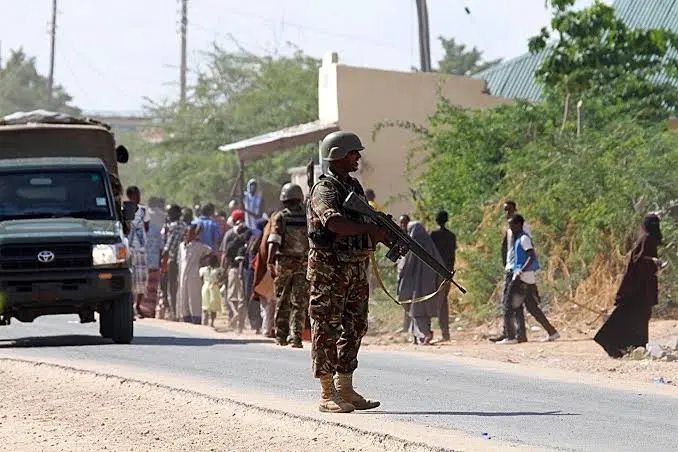
Al-Shabaab Attacks Kenya: 2 Deadly Border Raids in 48 Hours as Militants Strike Telecom Mast and Police Camp
Al-Shabaab attacks Kenya with alarming persistence along the northeastern frontier, and this weekend’s twin assaults underscore just how volatile the border remains. Gunmen believed to be al-Shabaab militants struck a Safaricom telecommunications mast inside a school compound in Abakaile village, Dadaab, at dawn on Sunday, sending teachers and residents scrambling for safety.
Security teams arrived at the scene around 4 a.m. to find the metallic door of the mast partially damaged. While no explosives were detonated and no injuries were reported among the teachers — all of whom were accounted for — the brazen nature of the attack, staged within an educational facility, has renewed fears about civilian safety in Kenya’s border counties.
The incident occurred less than 48 hours after suspected al-Shabaab fighters launched a separate assault on Arabia Police Station in Mandera County, firing rocket-propelled grenades and unleashing sustained gunfire from the south-eastern perimeter of the camp. Officers repelled the Friday night attack, and no casualties were reported, though security teams planned clearance patrols to determine whether the militants suffered losses.
Al-Shabaab Attacks Kenya: The Dadaab Telecom Mast Raid
Sunday’s raid on the Safaricom mast fits a well-documented militant strategy: severing communication lines to isolate communities and slow security response times. Telecommunications infrastructure has long been a favored target in the region, with masts in remote areas offering soft targets that cripple connectivity across vast, sparsely populated terrain.
The choice of a school compound as the attack site is equally significant. Since 2014, at least 42 teachers have been killed in Kenya’s northeastern counties, fueling an exodus of non-local educators and forcing the closure of numerous schools. The April 2015 massacre at Garissa University, where 147 students were slaughtered, remains one of the deadliest terrorist attacks in Kenyan history and a searing reminder of the vulnerability of educational institutions.
Al-Shabaab Attacks Kenya: A Pattern of Persistent Violence
The twin attacks underscore a grim reality: more than a decade after Kenya launched Operation Linda Nchi in October 2011 to push al-Shabaab back from its borders, the militant group continues to probe Kenya’s defenses with disturbing regularity.
According to data compiled by the Centre for Human Rights and Policy Studies (CHRIPS), Kenya recorded 72 terror-related attacks in 2025, resulting in 50 deaths and 94 injuries. While this represents a 15 percent decrease from the 85 incidents reported in 2024, the geographic concentration of violence tells a troubling story. Four counties bore the brunt: Mandera (32 attacks), Garissa (23), Lamu (13), and Wajir (4).
Security officials have consistently been the primary targets, accounting for roughly half of all attacks. In 2025 alone, 23 security personnel were killed, with Garissa recording the highest number of fatalities at 20.
How Al-Shabaab Attacks Kenya’s Critical Infrastructure
When al-Shabaab attacks Kenya’s telecommunications networks, the damage extends far beyond the physical mast. Disrupted mobile networks paralyze mobile money transfers, cut off emergency calls, and sever the flow of intelligence between security units and local informants.
The group’s targeting of critical infrastructure is deliberate. By degrading communication and transport links, militants create pockets of isolation where they can move freely, recruit youth, and stage larger operations without early detection.
Evolving Tactics, Expanding Threat
Al-Shabaab’s operational methods have grown increasingly sophisticated. Beyond direct assaults on police stations and military camps, the group has leaned heavily on improvised explosive devices (IEDs) — weapons prized for their portability, devastating impact on armored vehicles, and the psychological terror they inflict on road users.
In 2025, militants also escalated kidnappings to 18 abductions, the highest level in five years of monitoring. Victims have included local administrators, quarry workers, and miners. In one high-profile case in February, five chiefs were abducted in Mandera while traveling for official duties and held for two months before community elders negotiated their release.
The use of rocket-propelled grenades (RPGs), as seen in both the Arabia Police Station attack and a November 2025 assault on Hulugho Police Station in Garissa, signals access to heavier weaponry and a willingness to engage fortified positions head-on.
Border Dynamics and Regional Pressures
The surge in cross-border violence cannot be divorced from events inside Somalia. The ongoing drawdown of the African Union Transition Mission in Somalia (ATMIS), which has seen thousands of troops withdraw and hand over forward operating bases to Somali forces, has created security vacuums that al-Shabaab has exploited to regroup and shift fighters toward the Kenyan frontier.
Improved vegetation cover following heavy rains has provided better concealment for militant hideouts, including in Kenya’s Boni Forest, while the porous, nearly 700-kilometer border between Jubaland and Kenya’s Mandera, Wajir, and Garissa counties remains notoriously difficult to police. Intelligence reports have long warned that militants cross into Kenya and embed themselves within local communities, complicating counterterrorism efforts.
The Human Cost of Al-Shabaab Attacks in Kenya
Beyond the casualty figures, the persistent insecurity has inflicted deep socioeconomic wounds on Kenya’s northeastern counties. The flight of teachers has hollowed out the education sector. Local economies, particularly quarrying and trade, have been disrupted by abductions and IED attacks on transport routes. In Mandera, authorities were forced to suspend all quarrying operations in mid-2025 after repeated kidnappings of miners.
Community trust in security forces remains strained, with analysts noting that al-Shabaab has successfully exploited historical grievances, clan divisions, and perceptions of marginalization to recruit local youth and gather intelligence.
The Road Ahead
As investigations into the Dadaab mast attack and the Arabia Police Station assault continue, Kenyan security agencies face the unenviable challenge of securing vast, rugged terrain with limited resources. Heightened patrols, multi-agency operations, and cross-border intelligence cooperation with Somali and international partners remain central to the strategy.
Yet the militants’ ability to strike at telecommunications infrastructure, police installations, and civilian targets with impunity suggests that al-Shabaab attacks Kenya with a persistence that Operation Linda Nchi’s original objectives have not fully neutralized. For the teachers of Abakaile and the officers of Arabia, the dawn raids are a stark reminder that the shadow of Somalia’s decades-long conflict continues to stretch across Kenya’s northeastern border.
