
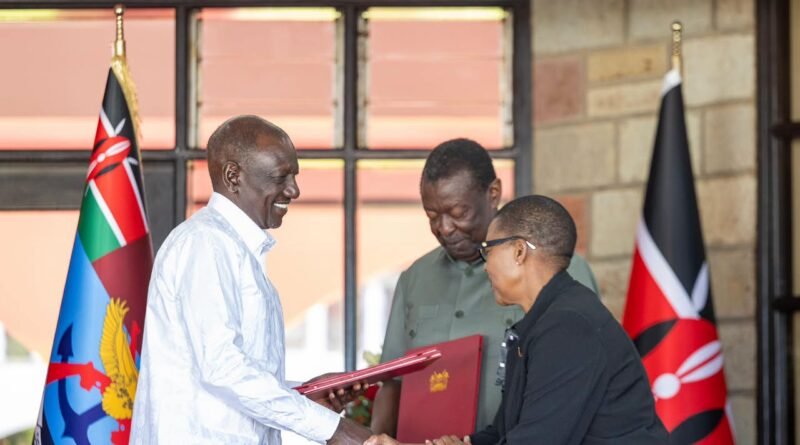
Ruto Signs KSh71.09 Billion County Allocations Law: What Changes for Kenya’s 47 Counties
ELDORET, October 19, 2026 — President William Ruto has signed the County Governments Additional Allocations Bill, 2026, into law, providing for KSh71.09 billion in additional resources to Kenya’s 47 county governments during the 2026/27 financial year.
The President assented to the legislation at Eldoret State Lodge in Uasin Gishu County on Monday. He also signed the County Assembly Services (Amendment) Bill, 2023, which introduces changes to the governance of county assembly administrations.
The additional allocations are worth approximately KSh71,091,926,967, according to figures presented during the assent. That is about KSh425.6 million more than the KSh70.67 billion provided in 2025/26. Although the total is sizeable, the year-on-year increase is relatively small: about six-tenths of one per cent.
Where will the KSh71.09 billion come from?
The legislation concerns resources that supplement counties’ ordinary equitable share of nationally raised revenue. These include conditional transfers from the national government’s share, statutory entitlements and funding associated with loans and grants from development partners. Conditions attached to specific allocations matter: not every shilling is available for governors to spend at their discretion.
Kenya’s counties have separately been allocated KSh428 billion in equitable-share revenue for the same 2026/27 financial year. The new additional-allocations law should therefore not be reported as replacing that KSh428 billion or as a single, unrestricted payment arriving immediately in every county account.
What services could benefit?
The President said the resources would support programmes in healthcare, agriculture, climate resilience, drought response, water and sanitation. During the signing, Senate Clerk Jeremiah Nyegenye also highlighted support for completing county headquarters and obligations affecting universal healthcare workers transitioning to permanent and pensionable employment.
For residents, the relevant question is how these earmarked resources translate into functioning services. A health allocation may support staffing or programme delivery, but patients only benefit when facilities have workers, supplies and accessible services. Likewise, spending on water infrastructure must be matched by operating systems, maintenance and clear responsibility for keeping projects functioning.
Why the allocations are not equal cash payouts
The law contains several categories of funding with different purposes and beneficiaries. A county’s entitlement depends on the applicable schedules and programme conditions, rather than dividing KSh71.09 billion equally among 47 counties. Some resources may also be tied to development-partner disbursement requirements.
County residents seeking the precise amount allocated to their county should consult the final law and its schedules, alongside county budget documents. Officials should be able to explain which programmes are funded, when transfers are expected, and how spending will be reported.
Second law changes county assembly administration
The County Assembly Services (Amendment) Bill, 2023, was also signed into law. The changes are intended to clarify procedures affecting County Assembly Service Board members and county assembly clerks, including suspension and removal processes, while addressing employment safeguards for seconded staff.
County assemblies approve county budgets and oversee county executive spending. Their administrative independence and fair employment procedures can influence how consistently assemblies carry out those responsibilities. Whether the reforms improve governance will depend on their implementation, not the presidential signature alone.
What happens after presidential assent?
Assent provides the legal foundation for the additional allocations, but it does not by itself prove that every programme has received or spent its money. Actual transfers and utilisation should be tracked through official budget implementation statements, Controller of Budget reports, county assembly oversight and audited financial accounts.
For taxpayers, the key measure will be whether the money reaches its intended functions and produces documented results in local hospitals, farms, water services and climate-related projects.
Sources: Kenyan Parliament — Budget and Appropriations Committee; Nairobi Leo, October 19, 2026; People Daily, October 19, 2026; and the President’s public statement of October 19. Daily Report KE has independently structured and contextualised the report.
