
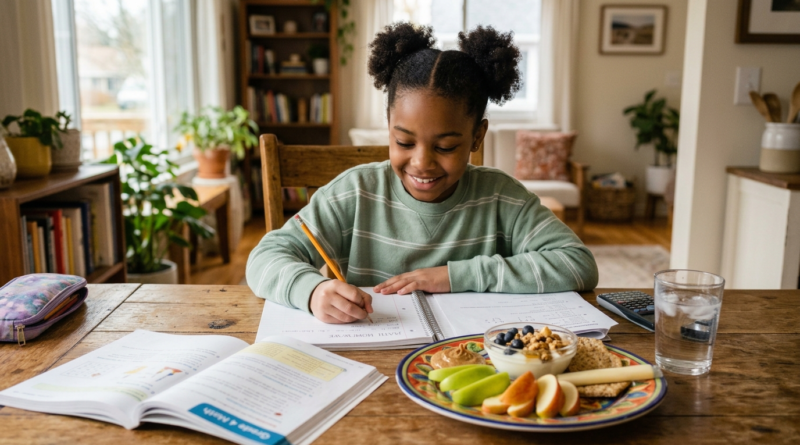
After-School Snacks That Help Kids Focus on Homework
Published: August 24, 2026
Author: Shadrack Kimeli
The third term has just opened across Kenya, and for most families that means the familiar afternoon routine is back: a tired child walks through the door, drops their bag, and heads straight for the kitchen. What happens in the next ten minutes often decides how the rest of the evening goes.
A child who eats the wrong thing or nothing at all before sitting down to homework is more likely to be irritable, distracted, or too drained to concentrate. The good news is that fixing this doesn’t require an elaborate meal. It just requires the right combination of foods.
Why the after-school snack matters so much
By 4 p.m., a child has usually gone five or six hours since lunch. Their blood sugar has dropped, and their body, still growing, burns through energy faster than an adult’s does, since children need roughly twice the calories per kilogram of body weight that adults require to support bone growth, muscle development, and general activity.
Skip the snack, and a child is running on very little fuel for homework. Choose the wrong snack, pure sugar, like biscuits or soda, and the body absorbs it quickly, causing a fast rise in blood sugar followed by an equally fast drop about twenty minutes later. This is often what parents describe as a child being “wired” briefly and then irritable or unfocused soon after. Pairing carbohydrates with protein, fibre, or healthy fat slows glucose absorption, which helps keep energy levels steadier for longer a more realistic and sustainable goal than expecting any single food to dramatically improve concentration.
The pairing rule that makes any snack work
Nutritionists generally agree on one simple principle: combine a carbohydrate with a protein, fibre, or a healthy fat. Carbs give quick energy; the protein, fibre, or fat slows digestion so that energy is released steadily instead of spiking and crashing. A few reliable macro pairings, with both local and internationally familiar examples:
- Complex carbs + protein — Banana with a spoon of peanut butter, or apple slices with almond butter. Quick to prepare, filling, and popular with most children.
- Protein + slow-release carbs — Boiled egg with a slice of wholemeal bread.
- Healthy fat + antioxidants — Plain yoghurt with chopped mango, pawpaw, or blueberries (a simple blueberry-and-Greek-yoghurt smoothie works well too), plus a spoon of oats for extra fibre.
- Fibre + whole grains — Hummus with whole-wheat pita strips, or roast maize/boiled sweet potato with a side of groundnuts for children who’ve had games or a long walk home.
- Leftovers as balanced snacks — A small portion of leftover githeri, beans, or ugali with sukuma wiki covers carbs, protein, and fibre in one go.
None of these need more than five minutes of preparation, which matters on a weekday when everyone is tired.
Keep sugary and heavily processed snacks occasional, not automatic
Crisps, sodas, sweetened juices, and packaged biscuits aren’t off-limits entirely, but they shouldn’t be the default. They tend to spike blood sugar quickly and leave a child hungry and unfocused again within half an hour. Keeping a few cut fruits or a boiled egg visible and ready in the fridge makes it more likely your child reaches for that instead of the biscuit tin, simply because it’s convenient.
Don’t forget water
Many parents focus entirely on food and forget that mild dehydration alone can cause headaches and poor concentration in children, especially after a hot, active day at school. A glass of water alongside the snack should be non-negotiable, and it’s a healthier default than a sugary drink.
Watch the portion, not just the food
A common mistake is over-feeding at snack time because a child says they’re “starving.” A large snack at 4 p.m. can mean a child who barely touches supper at 7 p.m., which then leaves them hungry again come bedtime. A good rule of thumb: if dinner is an hour or two away, keep the snack light (a piece of fruit, a boiled egg). If dinner is still three or four hours off, a slightly more substantial option like sweet potato with an egg is reasonable.
A simple afternoon checklist for parents
- Offer something within 15–20 minutes of arriving home; don’t let hunger build up before homework starts.
- Pair a carbohydrate with a protein or fat.
- Keep portions modest if dinner is close.
- Always include water.
- Save sugary treats for occasional, not daily, snacking.
There’s no need to overthink the after-school meal. A piece of fruit, an egg, some yoghurt, or a small plate of leftovers paired with water is usually enough to take a child from exhausted and irritable to alert and ready for homework.
This article is for general informational purposes only and reflects nutrition principles outlined by organizations such as the NHS on healthy snacking for children. It does not diagnose, treat, or manage any medical or clinical condition, including attention or behavioral disorders, and is not a substitute for professional medical or nutritional advice. Children with specific health conditions, allergies, or growth concerns should consult a pediatrician or registered dietitian.